Fish SVG File: A Designer’s Take on Graphics for Crafts
When I receive a new design asset to review for a client, my first instinct is not to look at the file size or the price tag. It is to assess its visual hierarchy, its scalability, and whether it carries enough weight to stand alone in a brand identity system. Recently, I was tasked with developing a visual concept for a boutique handmade soap line targeting the eco-conscious millennial market. The brief called for something organic, playful, yet polished enough to sit comfortably on premium packaging alongside serif typography. This is where the decision to evaluate the Fish SVG File became critical.
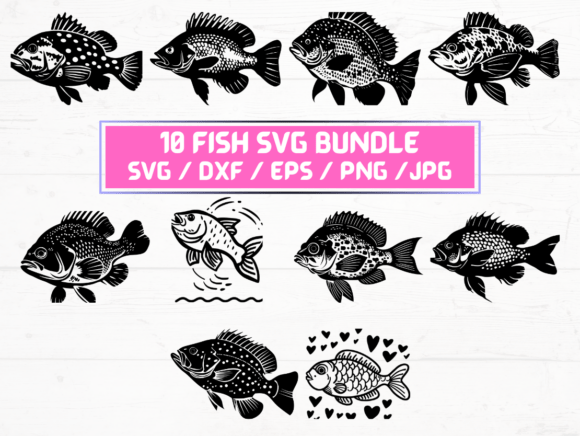
As a professional designer who works extensively with commercial design assets, I treat every graphic design asset as a potential building block for a larger narrative. The Fish SVG File arrived not just as a single image, but as a comprehensive design bundle. For those of us juggling tight deadlines for print-on-demand clients or Etsy product launches, the inclusion of multiple formats is often the deciding factor in whether an asset makes the cut. The package includes 10 SVG files, 10 PNG files at 300 dpi with transparent backgrounds, 10 DXF files, 10 JPG files, and 10 EPS files. This variety allows for seamless integration into both vector-based workflows like Adobe Illustrator and raster-based environments like Photoshop, or even cutting software like Cricut.
The Visual Mood and Creative Direction
Upon opening the primary SVG file, the immediate impression is one of clean, modern simplicity. In the world of crafts and Graphics, there is a fine line between "cute" and "tacky." This illustration walks that line gracefully. The lines are consistent, the negative space is well-managed, and the overall style feels contemporary rather than dated. For our hypothetical soap brand, this aesthetic aligns perfectly with a modern design philosophy that values clarity and minimalism without sacrificing charm.
The fish depicted is not hyper-realistic; it is stylized. This abstraction is crucial for logo design and marketing visuals because it ensures the icon remains recognizable even when scaled down. When I previewed the file on a mockup of a small jar label, the details held up remarkably well. It does not rely on complex gradients or shading that might get lost in print. Instead, it uses solid shapes and confident strokes, which is a hallmark of high-quality Svg design intended for versatile use.
Real-World Application in Client Projects
In my experience, a digital product must prove its worth across multiple mediums. Here is how the Fish SVG File performed during my practical testing for various project types:
- Packaging Design: The file’s clean edges make it ideal for die-cut labels. Because it comes with DXF files, it can be directly used for physical prototyping, allowing me to see how the shape interacts with real-world materials before finalizing the digital artwork.
- Social Media Graphics: For Instagram posts and Pinterest pins, the 300 dpi PNG versions provided excellent resolution. When placed against a soft pastel background, the fish acted as a strong focal point, drawing the eye without overwhelming the accompanying text. This balance is essential for effective social media graphics that need to stop the scroll.
- Merchandise and Apparel: I tested the SVG on a t-shirt design mockup. The vector nature of the file meant I could resize it to cover the entire chest area without any pixelation. The simplicity of the design ensured it would reproduce well on various fabric colors, a common challenge in t-shirt design.
- Crafting and Sublimation: For clients running Cricut projects or creating sticker designs, the inclusion of separate files for each variation (if applicable within the set) is invaluable. It saves hours of manual tracing and ensures precision in cutting paths.
This versatility confirms that the asset is not just a decorative clipart but a functional illustration capable of supporting a cohesive handmade business aesthetic. Whether used in a Canva template for quick social updates or integrated into a complex editorial design layout, the fish maintains its integrity.
Strategic Placement and Design Constraints
No design asset is perfect for every scenario, and part of my job is to identify where an element should not be used. While the Fish SVG File is robust, it has specific constraints that designers must respect to maintain visual trust and professionalism.
First, consider scale. At very small sizes, such as in a favicon or a tiny mobile app icon, the finer details of the fish may become indistinct. In these cases, using the simplified EPS version or creating a custom reduced-weight version is advisable. Second, avoid placing the asset in crowded layouts. If the background is busy or if there is competing text with similar visual weight, the fish will lose its impact. It works best as a hero graphic or a supportive accent in areas with ample white space.
Furthermore, be cautious with low-contrast designs. If you place a light-colored fish on a pale background, the readability suffers. Always test your creative design in black and white first. This grayscale check reveals whether the shape itself is strong enough to convey meaning without relying on color. Additionally, ensure that the asset fits the emotional tone of the brand. While playful, it may not suit a strictly corporate or legal firm’s branding unless the goal is to inject unexpected whimsy.
Technical Checklist for Professional Use
Before integrating the Fish SVG File into a final client deliverable, I always run through a rigorous technical checklist. This ensures that the design assets perform flawlessly in production.
- File Format Verification: Open the SVG in Illustrator to inspect the paths. Ensure there are no unnecessary anchor points or stray nodes that could cause issues during export or cutting. Check the EPS file to confirm all text is outlined if it needs to be editable in other programs.
- Transparency and Backgrounds: Review the PNG files at 100% zoom. Even with a transparent background specified, artifacts can sometimes appear around the edges. Clean up any anti-aliasing issues if necessary to ensure crisp rendering on screens.
- Contrast Testing: Place the fish on both light and dark backgrounds. Does it pop? Is the contrast sufficient for accessibility standards? Adjusting the opacity or adding a subtle drop shadow can help integrate it better into diverse layouts.
- Typography Pairing: Experiment with different font styles. A serif font might lend a classic, trustworthy feel to the fish, while a sans serif font keeps it modern and clean. Avoid pairing it with overly ornate script fonts unless the overall composition is carefully balanced. A handwritten font could enhance the handmade vibe, but ensure legibility.
- Commercial Licensing: Finally, and most importantly, verify the commercial license. Ensure that the purchase allows for use in end-products that will be sold, such as printed goods or digital templates. Clarify if there are limits on the number of items produced or if attribution is required.
Final Verdict for Designers
The Fish SVG File is more than just a cute illustration; it is a well-crafted graphic design asset that respects the principles of good design. Its clean vectors, versatile file formats, and adaptable style make it a strong candidate for small business branding, web design, and printable design projects. For designers looking to add a touch of aquatic charm to their creative marketplace offerings or client work, this asset delivers professional quality at a fraction of the time it would take to create from scratch. By understanding its strengths and respecting its limitations, you can leverage this SVG design to create compelling, cohesive, and commercially viable visual stories.